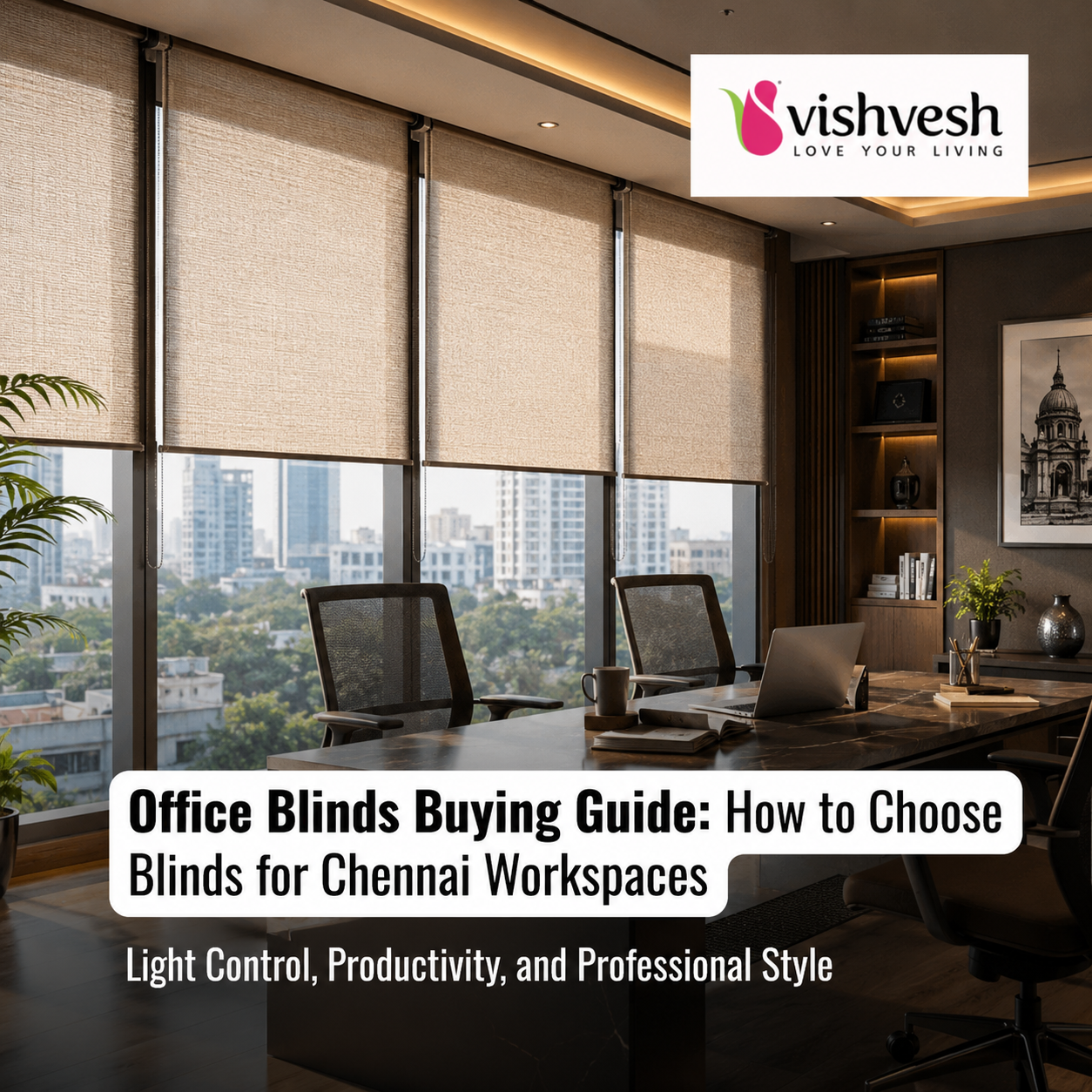
Choosing blinds for an office is a different task from choosing them for a home. The priorities shift toward glare control on screens, durability across many windows, a clean corporate look, and easy operation for staff. This guide explains the main office blind types, how to match them to different workspaces, and what to check before ordering for a Chennai office.
Why offices need different blinds
Offices run on screens, and screen glare is the most common complaint in poorly shaded workspaces. Blinds that control daylight in stages reduce glare without plunging the room into darkness.
Offices also value consistency and a professional appearance. Neutral tones and uniform blinds across many windows create a tidy, corporate look.
Durability matters because office blinds are operated frequently by many people. Robust mechanisms and hard-wearing materials last longer in shared workspaces.
Main office blind types
Vertical blinds
Vertical blinds use hanging slats that rotate to control light and privacy. They suit wide windows and floor-to-ceiling glass, common in modern offices.
Because slats hang vertically, they draw cleanly to one side for full window access. They are practical for large glazed facades and meeting-room walls.
Roller blinds
Roller blinds are single fabric panels that roll up and down for simple, clean light control. Sunscreen roller fabrics cut glare while preserving an outside view.
Roller blinds give a minimal, uniform look across many windows. They are easy to operate and maintain in busy offices.
Venetian blinds
Venetian blinds use horizontal slats that tilt to control light angle. Aluminium venetian blinds suit offices for their durability and clean finish.
Tilting slats give fine control over how much daylight enters and at what angle, useful for managing low morning or evening sun.
Motorized blinds
Motorized blinds use a tubular motor to raise, lower, or tilt slats by remote, switch, or app. They suit large, high, or hard-to-reach office windows and full glazed walls.
Scheduling lets motorized blinds adjust automatically through the day, cutting glare during peak sun without staff effort. See our motorized blinds page for details.
Matching blinds to office spaces
Open-plan workspaces
Open-plan offices need consistent glare control across long window runs. Sunscreen roller blinds or vertical blinds keep screens readable while retaining daylight and view.
Meeting rooms
Meeting rooms need adjustable privacy and blackout for presentations. Blackout roller blinds or layered blinds let a room switch from bright to dim quickly.
Private offices
Private offices benefit from a balance of privacy and daylight. Venetian or roller blinds give staff individual control over their own space.
Reception and client areas
Reception areas set a first impression, so a clean, premium finish matters. Uniform blinds in neutral tones support a professional look.
Glare, daylight, and comfort

Glare control is about managing daylight, not eliminating it. Good office blinds cut harsh direct sun while keeping useful natural light.
Sunscreen fabrics reduce glare and heat while preserving an outward view, which supports staff comfort and wellbeing. West and south-facing office windows in Chennai take strong afternoon sun and benefit most from these fabrics.
Reducing solar heat gain through blinds can also ease the load on air conditioning. This supports a more comfortable, efficient workspace.
Materials and maintenance
Aluminium and PVC blinds resist humidity and wipe clean, suiting Chennai’s climate and busy offices. Fabric roller blinds add a softer look but need gentle cleaning.
Choose robust, well-built mechanisms for offices, since blinds are operated many times daily. Cordless and motorized options improve safety and tidiness across a workspace.
Consider how easily individual slats or panels can be replaced. Modular systems make it simple to repair one damaged unit without redoing a whole run.
Safety and operation
Cord safety is important in shared workspaces, especially where children may visit. Cordless and motorized blinds remove hanging cords and reduce hazards.
Motorized systems allow central or scheduled control across many windows. This suits large offices where manual operation of every blind is impractical.
Planning an office blind project

Measure every window and note mount type, inside or outside the recess, before ordering. Offices often have many windows of slightly different sizes.
Plan for consistency by choosing one or two blind types and a shared colour palette. This keeps the fit-out looking uniform and professional.
Consider future flexibility, such as adding motorization later. A supplier can advise on systems that suit both current needs and later upgrades. If you are planning a wider fit-out, our guide to choosing flooring covers the floor side of the project.
Buying office blinds in Chennai
Vishvesh Textiles offers office and commercial blinds at its Cathedral Road, Chennai showroom, with selection guidance for glare control, durability, and a professional finish. Installation policy, project scope, and pricing are available on request and can be confirmed.
A consultation helps match blind type, fabric, and control method to each part of a workspace. Comparing options in person makes it easier to plan a consistent office fit-out.
Heat control and energy efficiency
Blinds do more than manage light; they also manage heat. Reducing solar heat gain through windows lowers the load on air conditioning in Chennai’s climate.
Sunscreen and reflective blind fabrics cut incoming heat while preserving daylight and view. West and south-facing office windows benefit most from this during strong afternoon sun.
Lower heat gain means a more even indoor temperature and potentially reduced cooling costs. This makes blind choice part of a workspace’s comfort and efficiency, not only its look.
Acoustics in the workplace
Hard office surfaces reflect sound, which can make open-plan spaces noisy. Fabric blinds and softer window treatments absorb some sound and reduce echo.
While blinds alone will not soundproof a room, fabric rollers and vertical blinds contribute to a calmer acoustic environment. This supports focus in busy workspaces.
Combining soft window treatments with other absorbent surfaces gives the best acoustic result. Blinds are one useful layer in managing office noise.
Blinds, curtains, or films for offices
Offices sometimes weigh blinds against curtains or window films. Blinds give the most precise, staged light control and a clean corporate look.
Curtains add warmth and insulation but suit fewer commercial settings and need more cleaning. Window films manage glare and heat permanently but cannot be adjusted through the day.
For most workspaces, adjustable blinds offer the best balance of control, appearance, and practicality. Many offices combine blinds with film on the most exposed glass.
Safety and compliance
Cord safety is a recognised hazard, especially where children visit or in shared spaces. Cordless and motorized blinds remove hanging cords and reduce this risk.
Commercial premises may have their own safety expectations for window treatments. Confirm any relevant requirements for your building before finalizing a specification.
Choosing safe, well-built systems from the start avoids retrofitting later. It also signals a considered, professional approach to a workspace.
Phasing a fit-out or retrofit
Large offices do not always fit out every window at once. Choosing a consistent blind system lets a business phase installation across floors or departments.
Selecting a system that can be motorized later gives flexibility as budgets allow. A supplier can advise on options that support both immediate and future needs.
Keeping records of the chosen fabric, colour, and system makes future additions match cleanly. This keeps a growing office looking uniform over time.
Choosing blind tones for offices
Colour affects how professional and calm an office feels. Neutral greys, taupes, and soft whites suit most workspaces and pair well with corporate interiors.
Lighter tones keep spaces feeling open and bright, while mid-tones hide marks in busy areas. A consistent palette across all blinds reinforces a tidy, uniform look.
Avoid strong colours that date quickly or clash with branding. A restrained palette keeps an office looking current for longer.
Managing glass walls and privacy
Modern offices often have glass partitions and meeting-room walls. Blinds on internal glass provide privacy on demand without losing the open, light feel of glazed design.
Adjustable blinds let a meeting room switch from open and collaborative to private and focused. This flexibility suits changing daily use.
Maintaining office blinds
A simple maintenance routine keeps office blinds working and looking their best. Regular dusting and occasional wiping of hard blinds prevents buildup in busy spaces.
Checking mechanisms periodically catches wear before a blind fails. Modular systems make it easy to replace a single damaged slat or panel without redoing a whole run.
Keeping a record of fabric, colour, and system helps source matching replacements. This keeps a large office looking consistent over years of use.
Cordless operation for shared spaces
Cordless blinds suit offices because many people use them daily. Removing cords creates a cleaner look and reduces a common safety hazard in shared spaces.
Cordless and motorized systems also reduce wear from repeated handling. Fewer moving cords means fewer parts to tangle, fray, or fail over time.
For busy workspaces, simple and robust operation matters. Blinds that are easy for anyone to adjust get used correctly, keeping glare and privacy managed through the day.
Daylight, comfort, and wellbeing
Natural light supports staff wellbeing and focus, so office blinds should manage glare without shutting daylight out. The aim is comfortable, usable light rather than darkness.
Sunscreen fabrics keep a workspace bright while cutting harsh glare and heat. This balance helps staff stay comfortable at screens through the working day.
Well-managed daylight can also reduce reliance on artificial lighting during the day. Good blinds contribute to a brighter, more pleasant, and more efficient workspace.
Key facts to remember
- Office blinds are chosen for glare control, privacy, and a professional finish across workspaces.
- Vertical and roller blinds suit wide office windows and floor-to-ceiling glass.
- Sunscreen roller fabrics reduce glare and heat while preserving an outward view.
- Motorized blinds suit large or high office windows and can be scheduled to cut peak-sun glare.
- Aluminium and PVC blinds resist humidity and wipe clean, suiting Chennai offices.
Key takeaways
- Office blinds prioritize glare control, durability, and a uniform look.
- Vertical and roller blinds suit wide windows and open-plan spaces.
- Meeting rooms benefit from blackout blinds for presentations.
- Sunscreen fabrics cut glare and heat while keeping the view.
- Motorized and cordless blinds improve safety and operation at scale.
Frequently asked questions
What are the best blinds for an office?
Vertical and roller blinds suit most offices. They cover wide windows, control glare on screens, and give a clean, professional finish. Sunscreen roller fabrics preserve the outside view while cutting glare.
How do office blinds reduce screen glare?
Office blinds control daylight in stages rather than blocking it fully. Sunscreen and adjustable blinds cut harsh direct sun on screens while keeping useful natural light in the workspace.
Which blinds suit meeting rooms?
Meeting rooms benefit from blackout roller blinds or layered blinds. These let a room switch quickly from bright daylight to a dim setting suitable for presentations and screen sharing.
Are motorized blinds worth it for offices?
Motorized blinds suit large offices with many, high, or hard-to-reach windows. They allow scheduled or central control, cutting peak-sun glare automatically and reducing the effort of manual operation.
Which blind materials suit Chennai’s climate?
Aluminium and PVC blinds resist humidity and wipe clean, making them practical for Chennai offices. Fabric roller blinds add a softer look but need gentler, less frequent cleaning.
How do I keep office blinds looking consistent?
Choose one or two blind types and a shared neutral colour palette across all windows. Uniform blinds create a tidy, professional appearance and simplify future maintenance and replacement.
Where can I buy office blinds in Chennai?
Vishvesh Textiles offers office and commercial blinds at its Cathedral Road showroom in Chennai. Installation policy, project scope, and pricing are available on request. Contact us to plan a workspace fit-out.