What is the difference between motorized blinds and motorized curtains?
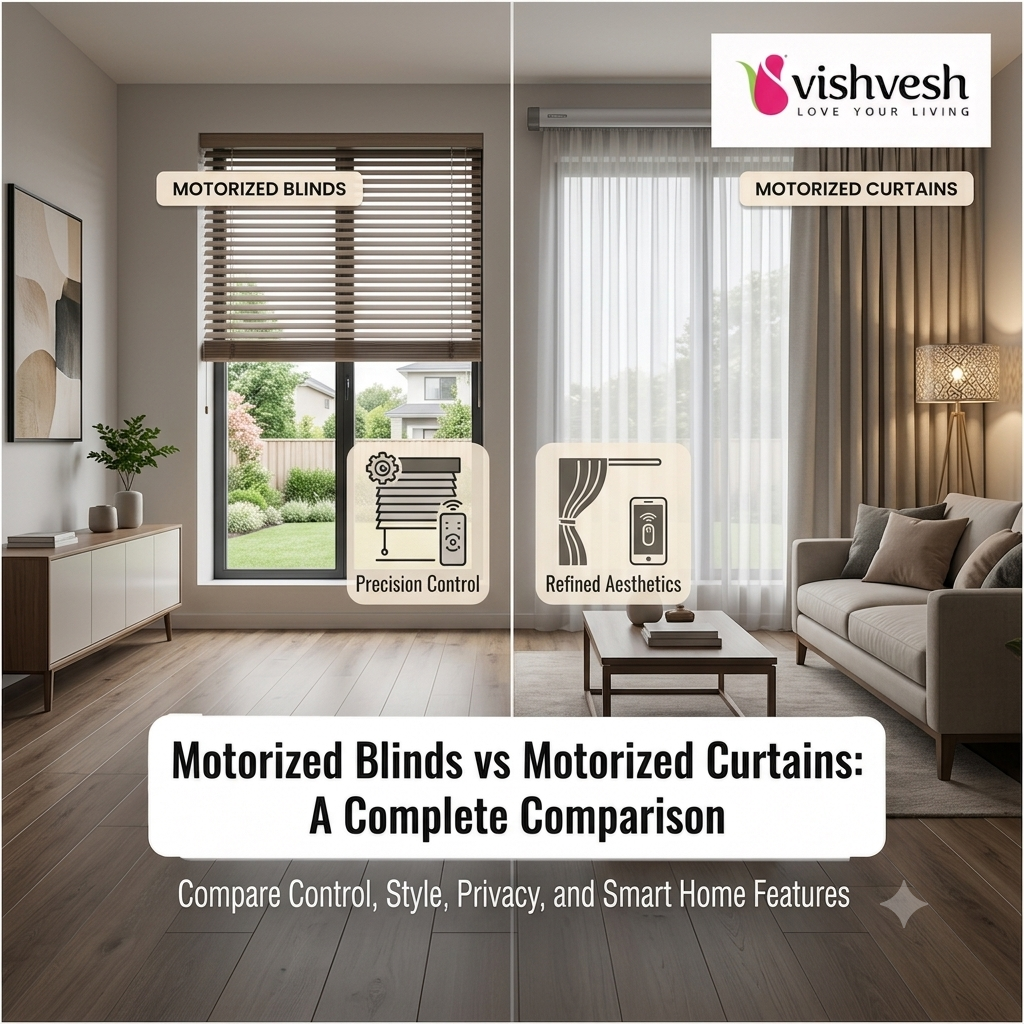
Motorized blinds and motorized curtains both use a motor and remote or app control to operate a window covering automatically, but they differ in mechanism and retrofit complexity. Motorized blinds generally replace an existing blind fitting and are often simpler to retrofit, while motorized curtains require a compatible motorized track installed specifically for that purpose, which usually means a more involved installation.
Home automation has moved well beyond lighting and security systems into the everyday mechanics of a room, and window coverings are one of the most requested additions. But motorized blinds and motorized curtains solve a similar problem in genuinely different ways, and the right choice depends on the window, the room, and the look a homeowner wants. This comparison breaks down how each system works, where each performs best, and how to decide between them for a Chennai home.
How Motorized Blinds Work
A motorized blind uses a small motor, typically battery powered or wired, connected directly to the blind’s roll or tilt mechanism. Instead of pulling a chain or wand, the user sends a command through a remote control, a smartphone app, or a voice assistant integration, and the motor moves the blind accordingly.
Many motorized blind systems also support scheduling, allowing blinds to open or close automatically at set times of day, which is useful both for convenience and for basic home security when a homeowner is away. Because the motor integrates into the existing blind mechanism, motorized blinds are generally simpler to retrofit into a home that already has manual blinds installed. To see the full range, explore our motorized blinds range.
How Motorized Curtains Work
Motorized curtains allow users to control window coverings using a remote or smart automation, but the mechanism is different from a blind. A motor is connected to a specially built track, and the motor drives the curtain fabric along that track rather than adjusting slats or a roller mechanism the way a blind motor does.
This means motorizing curtains typically requires installing a new motor-compatible track, since a standard decorative rod or manual track cannot simply be fitted with a motor afterward. For a homeowner starting from scratch, or already planning a track replacement, this is a straightforward addition. For a homeowner hoping to automate existing curtains without changing the track, it generally means a more involved retrofit than automating an existing blind would be. To see fabric and style options, browse our curtain range.
Motorized Blinds vs Motorized Curtains: Comparison Table
The table below summarises the main practical differences between the two systems, based on mechanism, retrofit ease, light control and control compatibility.
| Factor | Motorized Blinds | Motorized Curtains |
|---|---|---|
| Mechanism | Motor connected to the blind’s roll or tilt mechanism | Motor drives curtain fabric along a compatible track |
| Best for | Precise light control, minimalist rooms, hard-to-reach windows | Large windows, softness, sound dampening, premium look |
| Retrofit ease | Generally simpler; often replaces an existing blind fitting | Generally more involved; usually needs a new compatible track |
| Light control | Fine, adjustable via slat tilt (for slatted/venetian styles) | Strong, especially with blackout or heavily lined fabric |
| App / voice compatibility | Widely available depending on system chosen | Widely available depending on system chosen |
Pros and Cons of Each
Motorized Blinds: Pros and Cons
Motorized blinds are generally easier and less disruptive to retrofit into an existing room, since they usually replace a fitting that is already in place. They also tend to suit precise, fine-grained light control, particularly slatted or venetian styles that can be tilted to specific angles rather than simply open or closed.
On the other hand, blinds alone do not add the softness, colour depth or sound-dampening qualities that fabric curtains bring to a room, which is why many homeowners use blinds for light control and pair them with curtains for the finished look.
Motorized Curtains: Pros and Cons
Motorized curtains add fabric softness, colour, pattern and better sound dampening to a room, along with strong light-blocking performance when paired with a blackout or heavily lined fabric. They generally read as a more premium, considered design choice than blinds alone.
The trade-off is retrofit complexity: since a compatible motorized track is required, automating curtains is usually best planned during an initial curtain purchase or a full room renovation, rather than added to existing curtains as a quick upgrade.
Which Should You Choose
For Large Windows
Large picture windows or floor-to-ceiling glazing often suit motorized curtains, since a wide expanse of fabric adds warmth and softens a large area of glass in a way that blinds alone cannot. The motorized track distributes the weight of a wide curtain evenly, which also solves the practical challenge of manually operating a very wide curtain by hand.
For a Minimalist Look
A home office, study or minimalist-styled room often suits motorized blinds better, since blinds can offer precise light control without adding visual bulk to the window. A slatted or roller blind, motorized for scheduling and glare control, keeps the room’s clean lines intact while still solving the light-management problem.
For Retrofitting an Existing Room
For a homeowner automating an already-furnished room without wanting to replace existing curtains, motorized blinds are generally the lower-disruption starting point, since they can often be added without touching the curtains already in place. A homeowner planning a fuller renovation, where curtains are being replaced anyway, has a natural opportunity to specify a motorized-compatible track from the outset rather than retrofitting later.
Some homes use both systems together: motorized blinds close to the glass for fine light control, and motorized curtains further into the room for softness, privacy and sound dampening, both controlled from the same app or remote system for a single, coordinated automation setup.
Planning Your Automation Project
Neither system is inherently the cheaper or more expensive choice in every situation; the right answer depends on how many windows are being automated, whether new wiring is needed, and whether the project is a retrofit or part of a fuller renovation where cost planning happens alongside curtain and blind selection from the start.
Homeowners weighing both options are generally better served by discussing the specific windows involved during a consultation than by assuming one system is universally better, since a large living room window and a small home-office window can genuinely call for different answers.
Starting with the windows used most often, rather than trying to automate an entire home at once, is a practical way to manage both budget and installation timeline while still getting the day-to-day convenience benefit where it matters most.
A brief in-person demonstration of both systems, side by side, is generally the fastest way for a homeowner to form a genuine preference, since the difference between a motorized blind and a motorized curtain in operation is easier to feel than to describe. If accessories are also on your list, read our curtain accessories buying guide.
Installation Timeline for Each System
Motorized blinds generally have a shorter installation timeline than motorized curtains, since the process usually involves fitting the motor to an existing or new blind rather than installing an entirely new track system. For a straightforward retrofit onto a single window, this is often a relatively quick, low-disruption visit.
Motorized curtains typically take longer to plan and install, since the process includes track installation, curtain measurement and stitching, and final fitting, similar to the standard curtain installation process but with the added step of integrating the motor and its control hardware. Homeowners with a fixed timeline should discuss both systems’ realistic installation windows during the initial consultation rather than assuming they take the same amount of time. For the full step-by-step process, learn how curtain installation works.
For a full-home automation project covering many windows, staggering installation across the highest-priority rooms first, rather than attempting every window in a single visit, is often the more practical approach, both for scheduling and for spreading the cost of the project over a more manageable period.
Maintaining Motorized Systems Over Time
Both motorized blinds and motorized curtains generally need minimal ongoing maintenance beyond what a manual system would require, though battery-powered systems do need periodic battery checks or recharging depending on the specific product. Wired systems avoid this particular task but come with their own installation considerations discussed earlier.
Keeping the motor and track mechanism free of dust, particularly in a track-based motorized curtain system, helps the motor continue running smoothly over the years. A light dusting during regular room cleaning is usually sufficient, without needing to disassemble or specially service the hardware.
Software or app updates, where the system includes a smartphone app or smart home hub, are generally handled automatically by the manufacturer, though homeowners should confirm this during the consultation if long-term software support is an important consideration for their household.
Which Chennai Homes Choose Each System
Newer apartments and villas with larger picture windows and open-plan living spaces tend to lean toward motorized curtains, since the softness and sound dampening a fabric curtain provides works particularly well in a large, open room with hard flooring and multiple reflective surfaces.
Older homes being retrofitted for automation without a full renovation often start with motorized blinds, since they can be added to existing window openings with less disruption than a full curtain track installation, making them a natural first step into home automation for a household not yet ready for a bigger project.
Home offices, media rooms and spaces where precise, repeatable light control matters, such as adjusting glare on a screen or dimming a room for a projector, consistently favour motorized blinds for the fine-grained control they offer over a fabric curtain’s more binary open-or-closed operation.
Primary bedrooms in Chennai homes frequently end up with both systems layered together, using motorized blinds for daytime glare control and motorized curtains for full blackout and privacy at night, controlled from a single bedside app or remote for convenience.
Making the Final Decision
There is no universally correct answer between motorized blinds and motorized curtains; the right choice follows from the specific window, room and household priorities discussed throughout this comparison, rather than from a general preference for one category of product.
A useful way to approach the decision is to list each window being automated and note, for each one, whether light control precision, softness and sound dampening, or retrofit simplicity matters most. Windows where precision matters most generally point toward blinds, while windows where softness and a premium look matter most generally point toward curtains.
For households genuinely unsure which direction to take, starting with a single window automated with each system, one blind and one curtain, provides direct, lived experience with both before committing to a whole-home automation plan, which is often more informative than any amount of showroom demonstration alone.
Whichever system a household starts with, both motorized blinds and motorized curtains represent a meaningful upgrade in daily convenience over manual operation, and the choice between them ultimately comes down to matching the mechanism to the specific window rather than searching for a single universally superior option across an entire home.
For most Chennai households, the practical answer is not choosing one system exclusively but sequencing both thoughtfully across the home over time, automating the windows and rooms where it matters most first, and expanding the system as budget and priorities allow.
Key takeaways
Motorized blinds use a motor connected to the existing blind mechanism and are generally simpler to retrofit into an already-furnished room.
Motorized curtains need a purpose-built motorized track, which usually makes them better suited to a new curtain purchase or full renovation than a quick retrofit.
Blinds tend to suit precise light control and minimalist rooms; curtains tend to suit large windows, softness and a more premium, layered look.
Some homes automate both, blinds for fine light control and curtains for softness, controlled from a single app or remote system.
Frequently asked questions
Can both systems be controlled from one app?
Many app-controlled motorized blind and curtain systems can be connected to a broader smart home setup or a single control app, though exact compatibility depends on the specific brands and systems chosen.
Which is easier to retrofit into an existing room?
Motorized blinds are generally easier to retrofit, since they usually replace an existing blind fitting, while motorized curtains typically require installing a new compatible track.
Which suits large or unusually shaped windows better?
Motorized curtains often suit large or wide windows well, since the track distributes curtain weight evenly and solves the challenge of manually operating a very wide curtain by hand.
What about bay windows or unusual window shapes?
Bay windows and unusually shaped windows generally need a custom-configured track for motorized curtains, or a specially fitted blind, so these projects benefit from an in-person assessment before choosing a system.
Do both systems need dedicated wiring?
This depends on the specific system. Some motorized blinds and curtains run on rechargeable or replaceable batteries, while others may require wiring; a consultant can advise based on the exact products chosen.
Can I have both motorized blinds and motorized curtains on the same window?
Yes, some homes use motorized blinds close to the glass for fine light control alongside motorized curtains further into the room for softness and sound dampening, both controlled from the same system.
Which is better for a home office?
Motorized blinds often suit a home office well, since they offer precise, adjustable light control for screen glare without adding visual bulk to the window.
Is one system generally more expensive than the other?
Neither system is inherently cheaper in every case; cost depends on how many windows are automated, whether new wiring is needed, and whether the project is a retrofit or part of a fuller renovation.
Can I automate just one window to start?
Yes, many homeowners begin with a single high-value or hard-to-reach window and expand the system to additional windows later, whether choosing blinds, curtains, or a combination of both over time.
Which system installs faster?
Motorized blinds generally have a shorter installation timeline, since the process usually involves fitting a motor to an existing or new blind, while motorized curtains typically take longer due to track installation and custom stitching.
Do motorized systems need much ongoing maintenance?
Both systems generally need minimal maintenance beyond keeping the mechanism free of dust; battery-powered systems need periodic battery checks, while wired systems avoid this but have their own installation considerations.
Which system suits an open-plan living space better?
Motorized curtains often suit larger, open-plan spaces well, since the softness and sound dampening a fabric curtain provides balances the hard flooring and reflective surfaces common in open-plan layouts.
Can I layer motorized blinds and curtains on the same window for both privacy and light control?
Yes, this is a common setup in Chennai bedrooms, using motorized blinds for daytime glare control and motorized curtains for full blackout and privacy at night, both controlled from a single app or bedside remote.