What happens during curtain measurement and installation?
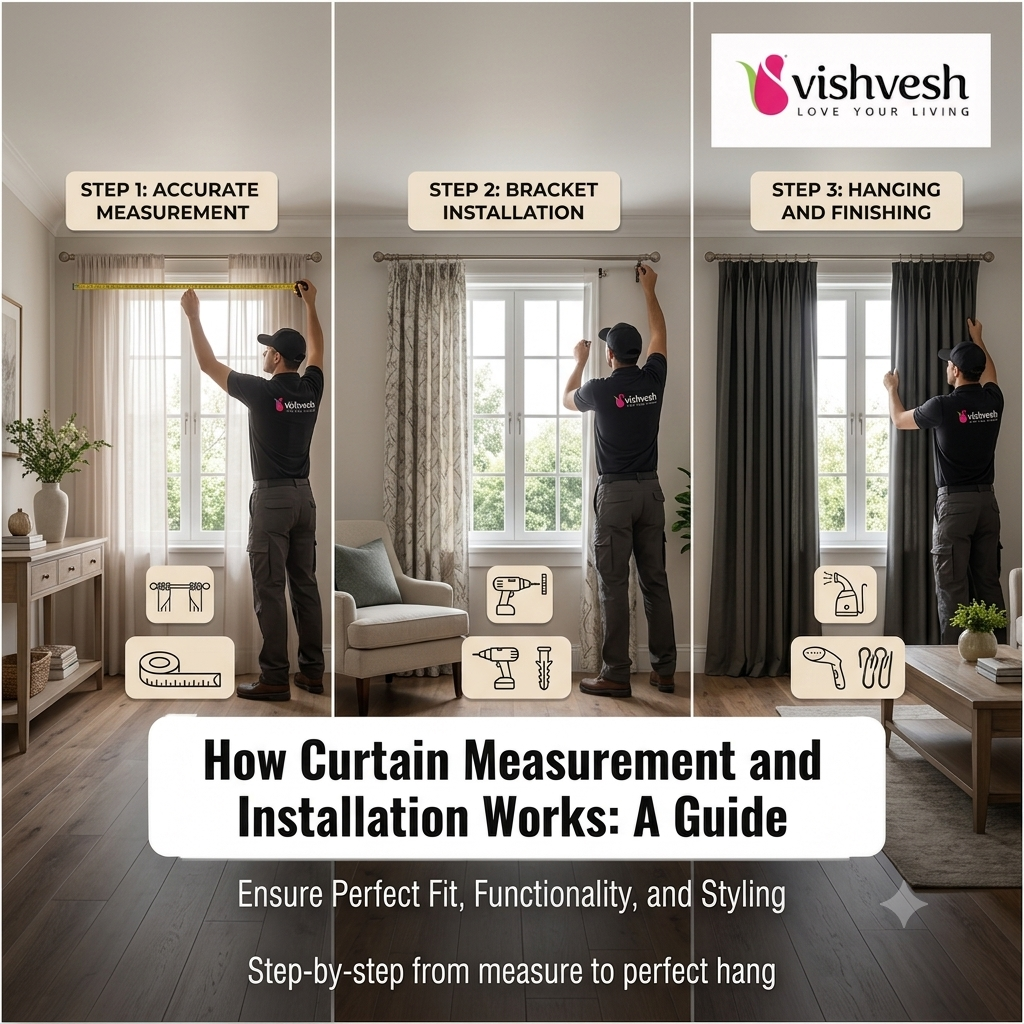
Curtain measurement and installation typically involves an initial consultation, an on-site window measurement, fabric and style selection, custom stitching, and a final professional fitting. Vishvesh measures every window on-site for a precise, tailored fit, so homeowners do not need to take their own measurements before the process begins.
Custom curtains are one of the few home furnishing purchases that cannot simply be picked up and taken home. Because they are made to measure, the process behind a well-fitted curtain matters as much as the fabric choice itself. This guide walks through exactly what happens between a first consultation and a finished installation, so first-time buyers, and NRI homeowners coordinating a project from overseas, know what to expect at each stage.
Step 1: In-Home or In-Showroom Consultation
The process typically begins with a consultation, either at Vishvesh’s Cathedral Road showroom or, for some projects, an initial discussion that can be arranged remotely before an in-person or on-site step follows. This first conversation covers which rooms are being furnished, each room’s light and privacy needs, and any style preferences the homeowner already has in mind. To see this in person, visit our Cathedral Road showroom.
For homeowners working with an architect or interior designer, this stage is also where curtain choices are checked against paint colours, flooring and other furnishings already selected for the broader project, so the final result reads as coordinated rather than picked in isolation.
Step 2: On-Site Measurement
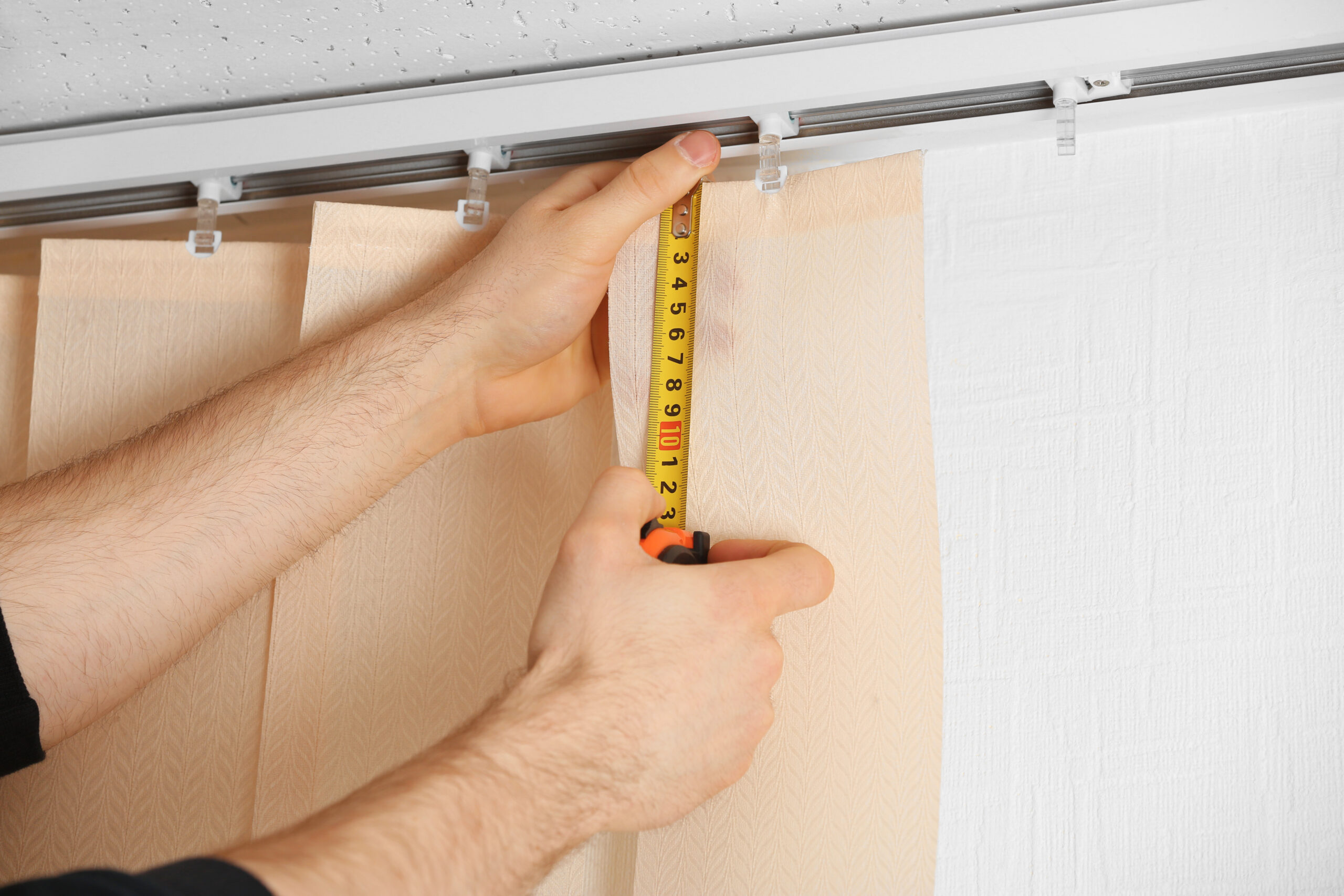
Curtain fabric is measured directly against each window’s width and drop, along with the chosen heading style, to ensure a tailored, properly proportioned fit once installed. Vishvesh measures every window on-site as part of the consultation process, rather than relying on customer-supplied measurements, which is one of the most important steps in the entire process.
Ordering curtains based on approximate or self-measured window dimensions, rather than a precise on-site measurement, is one of the most common causes of a poorly fitted final result, including curtains that pool too much on the floor or fall short of the sill. A professional on-site measurement removes this risk entirely, since the measurement is taken against the actual window, not an estimate.
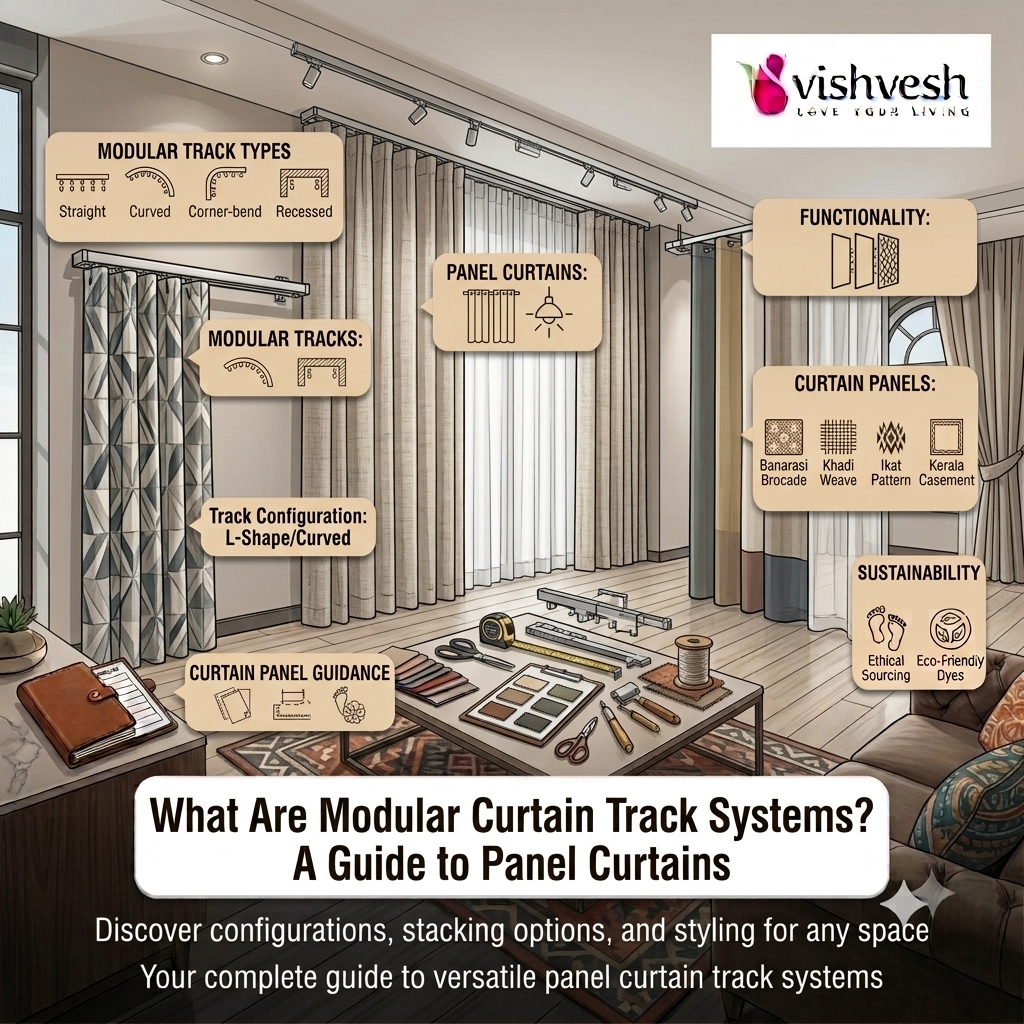
For a bay window, an oddly shaped opening, or a very wide span, on-site measurement becomes even more important, since these windows often need a custom-shaped track rather than a standard straight rod, and that decision can only be made accurately in person.
Step 3: Fabric and Style Selection
Once measurements are confirmed, fabric and style selection follows, informed by the light and privacy needs discussed in the initial consultation. Heading style, such as pleated, eyelet or tab-top, affects both the finished look and how the curtain gathers when closed, and is generally chosen alongside the fabric at this stage rather than as a separate decision. To browse fabric options first, browse our full curtain range.
This is also the point where accessories, rods, tracks, tiebacks and any motorised-compatible hardware, are matched to the fabric weight and window size, so the whole system, fabric and hardware together, is planned as one coordinated order rather than assembled piecemeal. To plan hardware alongside fabric, explore curtain and blind accessories.
Step 4: Stitching and Finishing
Once fabric and style are finalised, curtains are stitched to the confirmed measurements before being fitted and hung on-site. Custom stitching timelines vary depending on fabric availability and order volume; unspecified pending confirmation from the operations team, so homeowners with a fixed move-in date should discuss timing directly during the consultation.
Because each curtain is stitched to the specific window it will hang in, rather than cut from a standard size, the finishing quality tends to be noticeably higher than a ready-made alternative, particularly around hems, seams and heading construction.
Step 5: Professional Installation
After fitting, a final check of the curtain’s fall, alignment and hardware operation is typically carried out on-site to confirm everything functions and looks as intended before the installation is considered complete. This includes checking that the curtain glides smoothly on its rod or track, that tiebacks or holdbacks sit at the right height, and that any motorised hardware operates correctly on first use. If you are also considering automation, compare motorised blinds and motorised curtains.
For homeowners undertaking a larger renovation, this same visit often becomes an opportunity to discuss blinds, wallpaper, upholstery or flooring, since these categories are frequently planned together for a coordinated final look across a room or an entire home.
Homeowners are also encouraged to raise any questions about the finished installation at this stage, whether that concerns hardware operation, fabric care, or how the curtains will interact with an air conditioning vent or fan positioned nearby, since these small details are easiest to address while the consultant is still on-site.
What to Prepare Before Your Consultation
Bringing room photos, existing furniture colours, or fabric swatches you already like can help the consultation move efficiently, though none of this is required to get started. Homeowners planning a full room or full home project often find it useful to bring a floor plan or a simple room list, so the consultation can cover every window’s curtain needs in one sitting rather than across multiple separate visits.
For NRI homeowners furnishing a home in India remotely, the measurement and installation process is often coordinated through a local family member or the project’s architect, since accurate on-site measurement is difficult to arrange entirely from overseas. A video-call consultation is sometimes used as a first step, with the in-person measurement and fitting completed locally afterward.
Common Measurement Mistakes to Avoid
Relying on a room’s original builder measurements, rather than a fresh on-site measurement, is a common source of error, since small construction variances between windows in the same home are more frequent than most homeowners expect.
Measuring a window without accounting for the chosen heading style is another frequent oversight, since a pleated or eyelet heading changes how much fabric width is actually needed compared to the bare window measurement alone. This is one of several reasons a professional on-site visit, rather than a self-measurement, remains the most reliable step in the whole process.
Forgetting to measure drop length against the final curtain rod or track height, rather than the window frame itself, is another common mistake, since the rod is often mounted higher or wider than the window opening to let more light in when the curtains are open.
Skipping the final on-site check after installation, rather than confirming fall, alignment and hardware operation in person, can also mean a small issue goes unnoticed until well after the consultant has left, which is why this step is treated as a standard part of the process rather than an optional extra.
Assuming every window in a home needs identical treatment is a further misstep worth avoiding; even within a single room, orientation, sun exposure and adjacent furniture can justify a different heading style or fabric weight from one window to the next.
Why Professional Measurement Matters More Than It Seems
A window that looks like a standard rectangle can still have subtle variances in width from top to bottom, or a frame that is not perfectly square, both common in real construction even in newer buildings. A trained eye catches these variances during on-site measurement in a way that a quick tape-measure check by an untrained homeowner generally does not.
The margin for error in curtain measurement is smaller than it appears. A few centimetres of difference between the intended and actual drop length changes whether a curtain pools elegantly on the floor, sits precisely at the sill, or falls short in a way that reads as a mistake rather than a design choice. Professional measurement removes this risk by working directly against the confirmed hardware position rather than an estimate.
This is also why Vishvesh treats on-site measurement as a non-negotiable step rather than an optional upgrade, since it is the single factor most responsible for the difference between a curtain that looks tailored and one that looks slightly off, even when the fabric and style choices themselves are excellent.
After Installation: What to Expect
Once installation is complete, curtains generally need a short settling period, particularly heavier or fully lined fabrics, during which the fabric relaxes into its final drape. This is a normal part of the process and not a sign of a fitting issue.
Homeowners are encouraged to operate the curtains, opening and closing them fully, during the final on-site check, so any adjustment needed to rings, hooks or track alignment can be identified and corrected immediately rather than discovered days later during normal use.
For motorised installations specifically, this final check also includes confirming the remote, app or voice control setup functions correctly, since testing this while the installer is still present avoids the inconvenience of troubleshooting a smart home connection issue without support on hand.
Coordinating Curtain Installation with a Broader Project
For homeowners furnishing an entire home or undertaking a full renovation, curtain measurement and installation is generally most efficient when sequenced alongside other trades, such as after flooring is complete but before final furniture placement, so window measurements reflect the finished room rather than a space still mid-renovation.
Coordinating curtain installation timing with an interior designer or architect managing the broader project helps avoid scheduling conflicts, particularly when multiple rooms are being furnished at once and window treatments need to align with a broader move-in or handover date for the whole project.
Homeowners working with Vishvesh on a multi-room project often find it useful to sequence installation room by room rather than waiting for every room’s fabric to be ready simultaneously, allowing finished rooms to be used sooner while remaining rooms are still in progress.
A Realistic Picture of the Full Process
Taken together, the five steps covered in this guide, consultation, measurement, fabric selection, stitching, and installation, generally represent a more involved process than picking up a ready-made curtain from a shelf, and that is by design. The extra steps are what produce a tailored fit that a mass-produced size never could.
Homeowners who understand this process upfront, rather than expecting a same-day purchase-to-hang experience, generally find the timeline reasonable and the result worth the additional steps, particularly once they see the difference between a precisely fitted curtain and an off-the-shelf alternative hanging in the same room.
For anyone planning a renovation or move, factoring curtain measurement and installation into the overall project timeline from the outset, rather than treating it as a final, rushed step, tends to produce both a smoother process and a better finished result.
Ultimately, the process exists to remove guesswork from a purchase that is genuinely difficult to get right without professional measurement, and homeowners who engage with each step, rather than trying to shortcut to a faster result, consistently end up with curtains that fit and function exactly as intended, in a room that looks considered rather than assembled in a hurry.
Vishvesh’s Cathedral Road showroom team walks every customer through this same five-step process, whether the project is a single window or a full home, so that the experience of ordering curtains feels guided and predictable from the first consultation through to the final fitting.
Key takeaways
Curtain measurement and installation typically follows five steps: consultation, on-site measurement, fabric and style selection, stitching, and professional installation.
On-site measurement, rather than self-measurement, is the single most important step in avoiding a poorly fitted final result.
Accessories are chosen alongside the fabric during the same consultation, not as a separate decision, so hardware and fabric stay coordinated.
NRI homeowners can begin the process remotely, with a local family member or architect coordinating the on-site measurement and installation steps.
Frequently asked questions
Do I need to measure my own windows before a consultation?
No. Vishvesh measures every window on-site for a precise, tailored fit, so customers do not need to take their own measurements before a consultation.
How long does the process take from order to installation?
Timelines vary by fabric, customisation and order volume; unspecified pending confirmation from the operations team, so it is best discussed directly during the consultation.
Is installation included with a curtain purchase?
Yes. Vishvesh measures, stitches and fits curtains as part of a single consultation-to-installation process at the Cathedral Road showroom.
What should I have ready before a consultation?
Bringing room photos, existing furniture colours or fabric swatches you like can help, though this is not required to get started; a floor plan is useful for a multi-room project.
Can NRI homeowners complete this process remotely?
The measurement and installation process can be coordinated through a local family member or the project’s architect for NRI homeowners, often starting with a video-call consultation before the in-person steps.
What happens if a window is an unusual shape?
Bay windows or unusually shaped openings need on-site measurement to determine whether a custom-shaped track is required, which is why self-measurement is not recommended for these windows.
Can measurement and installation be scheduled around a specific move-in date?
Homeowners with a fixed move-in date should raise this during the initial consultation, since fabric availability and order volume both affect how closely stitching and installation timelines can be planned around a target date in advance.
Why does heading style affect the measurement?
A pleated or eyelet heading style changes how much fabric width is actually needed compared to the bare window measurement, which is why heading style is chosen alongside measurement rather than afterward.
Should curtain rods be mounted at the exact window frame width?
Not always; rods and tracks are often mounted higher and wider than the window opening itself to let more light in when curtains are open, which is why final measurements are taken against the planned hardware position.
Is a settling period normal after curtain installation?
Yes, curtains, particularly heavier or fully lined fabrics, generally need a short settling period during which the fabric relaxes into its final drape; this is normal and not a sign of a fitting issue.
What is checked during the final on-site installation review?
The final review typically confirms the curtain’s fall, alignment, and hardware operation, including opening and closing the curtains fully and, for motorised systems, testing the remote or app control.
Should curtain installation be sequenced with other renovation work?
Yes, curtain measurement and installation is generally most efficient after flooring is complete but before final furniture placement, so measurements reflect the finished room rather than a space still mid-renovation.
Can curtains be installed room by room during a multi-room project?
Yes, many homeowners sequence installation room by room rather than waiting for every room’s fabric to be ready at once, allowing finished rooms to be used and enjoyed sooner while other rooms remain in progress.
Choosing a track before you measure? Read about curtain tracks in Chennai.